Greg's Blog
Greg Laurie Says the Best Way to Discover Your Purpose May Be to Start Serving
Oct 21, 2026




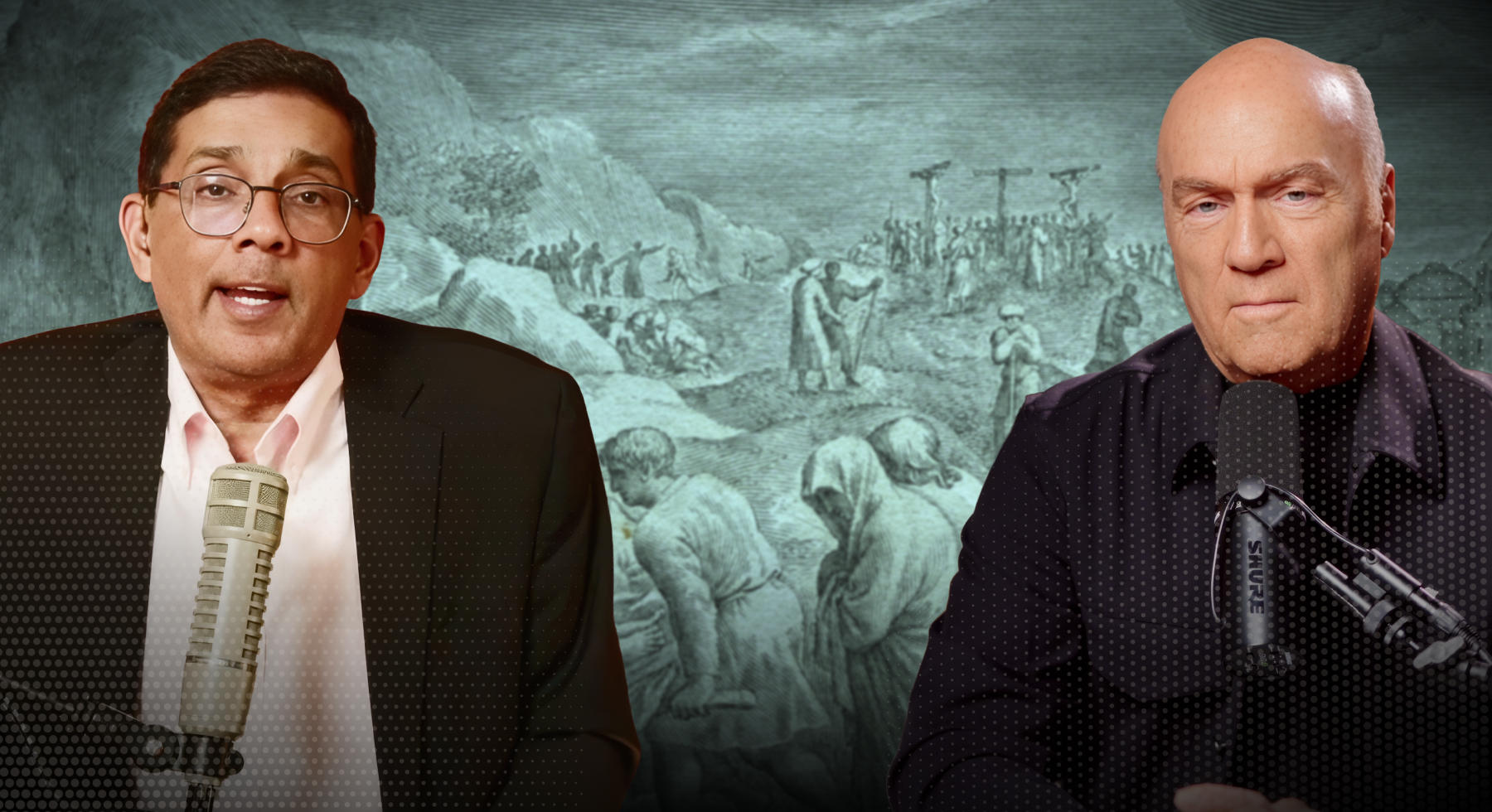
Does archaeology prove the Bible is true? Dinesh D’Souza spent three years digging into biblical archaeology for his new book, The Stones Cry Out.
And on The Greg Laurie Show, he walked us through some of the most Scripture-validating finds, from the bone box of Caiaphas, to a plaster inscription mentioning Balaam, son of Beor.
Greg Laurie: Well, you have a brand new book out that is titled The Stones Cry Out. So what is this book about, Dinesh?
Dinesh D’Souza: Well, as you know, Pastor Greg, I’ve written books in the past on Christian apologetics, but I wasn’t exposed to biblical archaeology until I went to Israel for the first time the end of 2022. I was very charmed to be kind of in the land of the Bible. These are places I had heard about and sort of dreamed about since I was a kid.
But then I was exposed a little bit to the artifacts that had come out of the ground, some of them in the last 50 years or even more, but some of them just in the last 10 years. And they are authenticating or validating the historicity of the Bible, the Old Testament and the New. I turned to my wife and I said, wow, why isn’t this information being shouted from the rooftops of every synagogue and church?
Dinesh D’Souza: Part of the reason we came up with was that the archaeologists are secular. Most of them have appointments in universities. They don’t want to be seen as proving the Bible, even though they’re doing so-called Near Eastern archaeology. So I thought, this is truly fascinating, because if the historicity of the Bible can be validated, even down to its minor details, that actually adds to the credibility of the whole.
Dinesh D’Souza: So I embarked on a kind of three-year project to really learn the field. Biblical archaeology has been around for about 150 years, since the second half of the 19th century. It’s made hundreds and hundreds of discoveries in the areas that relate to the Bible. And so [The Stones Cry Out] is a kind of summary of what we now know from biblical archaeology that corroborates the Bible.
I’m also happy to report that in 150 years, there is not a single important finding of biblical archaeology that contradicts the Bible.
Dinesh D’Souza: …I got to tell you, Greg, a lot of archaeology, as I’ve now experienced it, I’ve actually been in some of these digs, is very painstaking work. And not only that, but it doesn’t always excavate big things. We think of Agatha Christie’s novels, which are set against the spectacular backdrop of the pyramids. Or we think of Indiana Jones and these sort of great cities coming out of the ground.
Sometimes what will come out of the ground is a tiny, half-inch clay seal. These seals were used to seal correspondence. … The correspondence is lost, but the clay hardens and remains. So the clay seal will have a guy’s name on it. And the archaeologists won’t even know who that guy is. They’ll stick the clay seal somewhere in a museum or an academic storage facility.
And then three years later, somebody looks at that seal and they go, whoa, that guy’s in the book of Isaiah or that guy’s in the book of Jeremiah. And that guy might be a cameo appearance in the Bible, not an important figure. He’s mentioned in two lines and never again. And yet, once you’re looking at that clay seal, you realize that this guy, Jehucal, son of Shelemiah, has now jumped into the pages of history via the pathway of archaeology.
Greg Laurie: I remember when it was said by some, “Well, the Bible’s not true. It talks so much about Pontius Pilate. There’s no historical record of a Pontius Pilate.” But then, of course, they found the Pilate Stone. … Do you know Jeremiah Johnson? It seems like he mentioned something about a Pilate ring that’s been discovered more recently. And you alluded to the fact that some recent discoveries have been really significant. So what are some of those recent discoveries?
Dinesh D’Souza: Well, just in the last several days, archaeologists have confirmed the location of biblical Bethsaida, which is a location where Jesus did miracles. What happens is sometimes these biblical places get lost. Obviously, biblical places don’t come with name tags. You’ve got to correctly identify a location.
Dinesh D’Souza: Now, I’ll give an example. Since you mentioned Pontius Pilate, my mind flashes to the great trial scene of Jesus. He’s arrested. He’s taken to the home of the high priest. And so the major figures here are King Herod, Pontius Pilate, the high priest Caiaphas, and of course, the accused man, Jesus. Now, there’s really interesting archaeology on all four of these men, but I want to focus for a moment on Caiaphas, because the Bible just gives one name. He’s Caiaphas. But the Jewish historian named Josephus tells us that his first name is Joseph Caiaphas.
Now, if we fast forward 2,000 years, they were recently digging in the aristocratic, or priestly quarter, of Jerusalem. And out of the ground come a bunch of these … ossuaries; they’re stone boxes. And in the first century AD, if you died, your bones were taken out of the tomb—you were buried in a tomb, but then when your body decayed, they would take your bones out and put them in a box and put your name on it. So that’s the ossuary.
So these archaeologists are looking at about 20 of these ossuaries, and one of them is particularly ornate, and it stands out, and they look more closely, and the name on it is as follows: Yehosef bar Qayafa. So Yehosef is Joseph, bar is son of, Qayafa [is] Caiaphas. And you look inside the box and it’s the bones of a 60-year-old man. And the bones are then dated, and they date to the first century AD. So it’s Caiaphas.
Think about it. You’ve preached about these great scenes where Caiaphas is stirring up the Sanhedrin, and then they go to Pilate, who is, of course, reluctant to crucify Jesus, but Caiaphas is insistent. This man, this villain of the Bible, we’re not just talking about his name popping out on a stone inscription or some sort of a writing on the wall. You’re actually looking at his bones. … Archaeology gives you this chilling feeling. These real people and places and events kind of spring to life. And I think it’s a great encouragement to the believer and a little bit of a bafflement, or it confounds the skeptic.
Greg Laurie: On my last trip to Israel, they took me to a site that had at that point not been made open to the public yet, the Pool of Bethesda. And what was so exciting to me about that is here’s this narrow pathway that they said Jesus would have walked across on his way to the temple.
People always want to know, where did Jesus walk? And the problem is there’s layers of civilization in Jerusalem. The Crusaders built over this and someone else built over that. And so a lot of the places where Christ actually walked are 30 feet below.
But there’s a couple of spots, the Southern Steps. We know he would have been on those steps somewhere. But when you walk past the Pool of Bethesda, you are on the actual path that Christ himself would have walked. Have you seen that one in particular? And do you have anything you’ve discovered about that site?
Dinesh D’Souza: Yes.
There are really two famous pools that were lost to history and have been discovered very recently: the Pool of Bethesda and the Pool of Siloam. Now, both of these are highly significant because Jesus performed miracles at each one.
The Pool of Siloam is huge. It’s the size of an Olympic swimming pool. And for a long time, historians thought that these pools were going to be small places for ritual baths. But it turned out that these pools were huge, and out-of-town Jews, which, by the way, is including Jesus, right? Jesus lived in the northern part of Israel. He would come to Jerusalem for holy days or holidays. He would bathe in the Pool of Siloam or cleanse himself ritually, and then he would walk the pilgrimage road about 500 meters to the temple.
So, like you said, there are certain places where people don’t know exactly where Jesus walked. They’ll say, well, the Via Dolorosa is over here, or no, we think it’s over there. But it seems beyond a doubt that he would have bathed in this particular pool and walked this pilgrimage road to the temple, because that was standard for out-of-town Jews in Jesus’ time.
Greg Laurie: What are your thoughts on the Garden Tomb? Do you believe that? How would you rate that? Like, I think 90% that’s the tomb Jesus was buried in…?
Dinesh D’Souza: I think that for some time there was kind of a legitimate dispute about the site of Jesus’ crucifixion. Is it at the site of the Garden Tomb, or the site of the Church of the Holy Sepulchre?
Now, the best argument for the Church of the Holy Sepulchre is that in the second century—by the way, just a few decades after Jesus’ death and after the apostles lived—the Roman emperor Hadrian decided to stamp out all the Christian sites. And he knew what they were because there were Christians at that time alive who had known the apostles. So what does Hadrian do? He goes and he builds pagan monuments on top of those sites.
And ironically, this despiser of Christianity unwittingly ends up marking some of those sites by doing this. So in the fourth century, when Constantine converted to Christianity, he sent his mother to Jerusalem. She just knew where to look, right? She went and found all those pagan sites. She took them down, and she usually built churches right on top of them. Now, that’s the site of the Church of the Holy Sepulchre, which has been for centuries the traditional site of the crucifixion.
In the 20th century, some people began to doubt that because they thought that the Church of the Holy Sepulchre was inside the city of Jerusalem. And as you know from the Bible, Jesus was crucified outside the city. So this was the kind of serious objection to that particular site. But subsequent archaeological work—more recent—has confirmed that Jerusalem was obviously much smaller in the old days than it is later. So, as it turns out, in Jesus’ time, the Church of the Holy Sepulchre was indeed outside the city, just as the Bible says. And for that reason, I think that is the most likely spot for Jesus’ crucifixion.
Greg Laurie: …And you know, there’s no doubt that there’s a connection to the Holocaust, because after the loss of six million Jewish people, I think they understood that we need our own homeland. And it was as if on cue, and I believe they were on cue, because actually, according to Ezekiel 37, 38, 39, it’s a sign of the last days. He even says repeatedly that this will happen in the last days. So it seems to me that this is an indication or a fulfillment of Bible prophecy that Christ is coming back.
Dinesh D’Souza: You know, there’s an archaeological tie-in to this, which is that the greatest discovery of biblical archaeology in the 20th century is the Dead Sea Scrolls. And what do the Dead Sea Scrolls do? Well, they basically confirm the accuracy of the Hebrew Bible. The oldest Hebrew Bible prior to the Dead Sea Scrolls was from about 1000 AD. So think of it, more than a millennium after the events that it’s talking about.
So a lot of skeptics were like, wait a minute, the scribes could have made changes, they could have made additions and subtractions. How do we know that the Hebrew Bible, the Old Testament that we’re reading now, is the same one that Jesus read? Well, the Dead Sea Scrolls, which were dated back to somewhere between the third century BC, before Jesus, to about the first century BC or even AD, they confirmed that the Hebrew Bible had not been altered, had not been changed in any meaningful way.
And guess what? What was the year that the Dead Sea Scrolls were discovered? Answer: 1947. One year before the founding of the state of Israel. … So it’s almost as if the ancestral history—the presence of the Jews in their ancient homeland, the great charter of the Jews, namely their Hebrew Bible, is validated 12 months before Israel is reconstituted as a nation.
Greg Laurie: So if you were talking to a nonbeliever, Dinesh, and you were going to argue the reliability of Scripture on archaeology alone, what archaeological discovery would you refer to that you think is one of the more compelling?
Dinesh D’Souza: …I picked this one because it is one that the skeptics were gloating over for a long time. When the Israelites are crossing over from Egypt through the desert, they’re coming to the Promised Land, they have to go through Jordan, which is at that time Moabite territory. The Moabites are the enemies of the Israelites, and the king of Moab, Balak, he rounds up a fortune-teller named Balaam, son of Beor, and he tells this guy, you need to curse the Israelites. It’ll give them all kinds of problems.
And this Balaam guy is ready to do it, but the Bible says that God stops him. God prevents him from cursing the Israelites. Now, in the Bible, this Balaam has a donkey. It’s a talking donkey. So you can just imagine the skeptics are like, this is ridiculous. This thing is all made up. It’s obviously some kind of preposterous legend.
Except, let’s come to a few decades ago. They’re digging in Jordan, and these are secular archaeologists, and they find an old plaster inscription. And it says as follows: the warnings and sayings of Balaam, son of Beor. So number one, it’s Balaam, same name. And you might say, well, there could be two Balaams or three Balaams, but it’s Balaam, son of Beor, same dad. Not only that, it’s in the right location, which is Jordan, Moabite territory. And finally, what’s his job? The warnings and sayings of Balaam, son of Beor, indicates he’s some sort of a soothsayer, he’s some sort of a fortune-teller. So this Balaam, again, this preposterous character with a talking donkey, is now historically validated.
And so my argument to the skeptics goes something like this. Look, you cannot with archaeology prove the theology of the Bible. I’m not trying to prove the miracles. But guess what? If the archaeology is true down to its minute detail, stretching over the entire 2,100-year history of the Bible, all the way from the patriarchs to the book of Acts, if I can show you a hundred archaeological artifacts that corroborate the Bible with not a single one going in the opposite direction, doesn’t that enhance the credibility of the Bible as a whole?
Greg Laurie: Yes. Our mutual friend, Frank Turek, he’ll go out on college campuses and take questions from students. And he told me recently that atheism is not as prominent as it once was, that now it’s kids asking questions more about personal lifestyle choices, and he poses a question to them.
Frank will ask the students, if I could prove Christianity is true, would you believe it? And he said many of them say no. So it’s not always an intellectual issue. It’s not always “convince me with archaeology…” It’s simply that they don’t want to live by the teachings of what the Scriptures say. As Jesus said, people don’t come to the light because they don’t want their evil deeds to be exposed.
So there comes a point where we can make the intellectual arguments, and I recommend people get your new book, The Stones Cry Out, to help with those intellectual arguments, which have their place. But ultimately, it comes to the person willing to turn their back on sin and put their faith in Christ.
Dinesh D’Souza: I agree. The most that archaeology, the most that Christian apologetics can do, is remove the rational obstacles to belief…

To help you get started, we would love to send you a free Bible and other resources to help you grow in your faith.
Get Resources